Swiss National Day: Why Switzerland Celebrates on 1 August
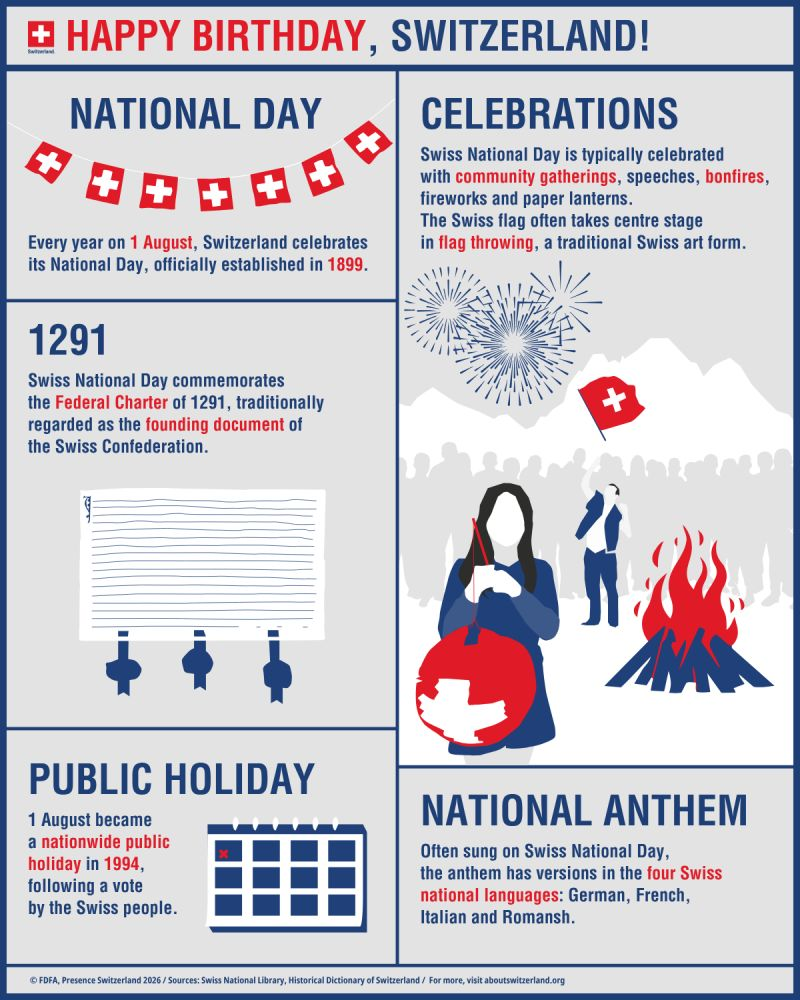
Infographic explaining the history and traditions of Swiss National Day on 1 August. © FDFA, Presence Switzerland 2026.
On 1 August, Switzerland turns red and white.
Swiss flags appear on balconies, lanterns decorate neighbourhoods, bonfires light up hillsides and communities gather for music, speeches and fireworks. For newcomers, it is one of the best opportunities to experience Swiss traditions beyond the familiar images of mountains, chocolate and efficient trains.
But why does Switzerland celebrate its National Day on 1 August?
The story begins in 1291
Swiss National Day commemorates the Federal Charter of 1291, an agreement between the communities of Uri, Schwyz and Unterwalden.
The three founding regions promised to assist one another against external threats and injustice. The document, considered Switzerland’s oldest constitutional charter, was dated only to the beginning of August rather than specifically to 1 August. The date was chosen much later as a symbolic anniversary. (Swiss Government)
According to Swiss legend, representatives of the three regions also gathered on the Rütli meadow overlooking Lake Lucerne and swore an oath to defend their freedom. The Rütli remains one of the most important locations for National Day commemorations. (About Switzerland)
It is worth remembering that Switzerland did not become a modern federal state until 1848. Therefore, describing 1 August as Switzerland’s “birthday” is more celebratory than historically precise.
When did 1 August become National Day?
The first major national jubilee connected to the Federal Charter took place in 1891.
From 1899, the Federal Council encouraged the annual celebration of 1 August as the National Day of the Swiss Confederation. Church bells, official speeches, flags and bonfires gradually became part of the tradition. (Swiss Government)
However, it did not become a nationwide public holiday until 1994, following approval by Swiss voters in a 1993 referendum. (Swiss Government)
How Switzerland celebrates
There is no single way to celebrate National Day. Every canton and municipality adds its own character, but several traditions can be seen throughout the country.
Community celebrations
Local gatherings often include speeches by municipal or cantonal representatives, live music, food stalls and activities for families.
These celebrations reflect something deeply Swiss: national identity expressed through strong local communities rather than through one enormous central event.
Bonfires and fireworks
As evening approaches, bonfires are traditionally lit on hills and mountains. Fireworks are also common, although residents should always follow local safety rules and any restrictions announced by their municipality.
Lanterns and Swiss flags
Children sometimes walk through their neighbourhoods carrying paper lanterns decorated with the Swiss cross or their canton’s coat of arms. Streets, homes and balconies are covered with red-and-white flags. (About Switzerland)
Alphorns, yodelling and flag throwing
Traditional costumes, alphorn performances, yodelling choirs and Fahnenschwingen, the traditional art of flag throwing, frequently feature in public celebrations.
These traditions may appear ceremonial to outsiders, but they remain an important part of Switzerland’s living cultural heritage. Read more about the languages spoken in Switzerland.
The 1 August farm brunch
One of the most enjoyable National Day traditions is the 1 August farm brunch, known locally as the Buure-Zmorge.
Participating farms serve regional products such as braided bread, cheese, cold meats, rösti, eggs, jam and Bircher muesli. Many farms require advance registration because the brunches are extremely popular. (My Switzerland)
For newcomers, this is an excellent way to meet local families, support Swiss farmers and experience the country beyond its cities.
The Swiss national anthem
The anthem sung during many National Day celebrations is the Swiss Psalm.
Its melody was composed by Alberik Zwyssig, while the original German lyrics were written by Leonhard Widmer. It was used provisionally from 1961 and officially adopted as Switzerland’s national anthem in 1981.
Versions exist in all four national languages: German, French, Italian and Romansh. (About Switzerland)
More than flags and fireworks
Swiss National Day celebrates much more than a historical document.
It reflects the principles that continue to shape the country: cooperation between different regions, political participation, local responsibility and unity across linguistic and cultural boundaries.
For international residents, 1 August is also an invitation to participate. Attend your commune’s celebration, listen to the speeches, try a farm brunch or simply join your neighbours as the lanterns and bonfires begin to glow.
You do not need to have been born in Switzerland to appreciate the values being celebrated.
Happy Swiss National Day, or, as you may hear locally: Schönen 1. August!
